Tomorrow, November 1st, is All Saints Day. What's that? If you're American, chances are you don't even know. I would bet that if you took a random selection of Americans, from both rural and urban areas, that more than half of them couldn't tell you when and what All Saints Day is. I only found out about it because apparently it's the Anglo equivalent of Dio de Los Muertos, which is celebrated in San Francisco, where I used to live.
Well, all Germans sure do know about All Saints Day. Why? Because it's on the long roster of national holidays! That's right: make sure you go grocery shopping on October 31st (which, incidentally is not Halloween as that doesn't really exist here), because ain't nothin' open on November 1st.
And November isn't the only month which has a national holiday on its first day, May 1st is also a holiday. I don't even know what it's called, but it's about celebrating workers by not working. In fact, May is the month which holds the most of these one-day wonders. I'm too lazy (and Babu will wake up from his nap too soon) to look it up, but there are something like 4 or 5 one-day holidays in May. They all fall on Mondays and Thursdays. The school where I teach even offers students whose regular lessons happen on Mondays or Thursdays an extra free Saturday workshop in May to make up for all the classes they miss due to these holidays. Most of these one day holidays are Catholic or Christian, days that in America only nuns and cardinals observe. That's why I can't even translate the German names into English because they're days I'm not even aware of in English.
On the subject of holidays and translations, German has a word which doesn't exist in English, simply because we don't have the need since we don't have all these holidays: Brückentag. It means, literally, bridge day, and it's the Friday between one of those Thursday holidays and the weekend....or, as the case with tomorrow's holiday which falls on a Tuesday, the Monday which bridges the day off to the weekend. Lots of people use one of their given days off from work on a Brückentag to make a four day weekend.
Which brings me to the next related point: German employees get 30 paid days off per year. That's six work weeks per year. In addition to all these one-day holidays (I think there are around 10-12 of those, depending on the state). So that means the average German works 10 out of 12 months per year, so to speak. This is one aspect of European (it's not just German) culture I can really get behind! In fact, it's one of the reasons I would be reluctant to move back to America. Americans get, on average, 10 paid days off per year. If they're lucky. Many can not or do not actually get to take these days, and if I'm not mistaken in most states there's no law guaranteeing they get them. It's not unusual for an American to go years without a holiday. That would never, ever happen here. Not only is it forbidden by law, but it's so deeply ingrained in the culture that it would be unthinkable to either willingly or by force miss out on your holidays. Germans gasp at the idea of only 2 weeks paid vacation per year. As well they should! Not only do Americans get cheated on paid vacations, but these Christian holidays (like All Saints Day) are not days off ~well, besides Christmas and Easter Monday. Sure, they have Presidents Day, Memorial Day, Labor Day and July 4th ~none of which exist here~ but in comparison to Europe, Americans have a serious lack of vacations.
One might be tempted to believe Americans, since they work far more hours per week and days per year than Europeans, are hard workers. Alas, this is not the case. My theory goes that since Americans are expected to work long weeks, often with unpaid overtime (in Germany the average workweek is 38 hours and overtime is, by law, always paid, very often in, you guessed it: days off!), they get their revenge by slacking off and not working all that hard. Whereas Germans, to whom holidays are an entitlement just like food, shelter and water, are some of the most hard-working and efficient folks on this planet (yes, another true stereotype!). Germans take their work very seriously, but they also take their leisure time just as seriously. (Count on the Germans to make fun a serious endeavor!). Here's a beautiful German word that has no English equivalent: Feierabend. Feier means celebration and Abend means evening. Feierabend means when you get off work and then have the evening to do with what you please. It's the time of day when you arrive home, have a drink and plan your next holiday. I love that Germans honor this feeling: "Yay! Work is over for today!" with its very own word.
As I said, I am in full favor of this aspect of German / European culture. I would miss it very sorely if I ever moved back to the US. However, there are two down sides: if you are a freelancer, none of this applies to you. My hubby is a freelancer, and I was for many years. Freelancers do not get any paid holidays. Of course they get the national holidays off, but they're unpaid. It's kind of expected that they, too, will take those precious 30 days off throughout the year, so they do "get" them, so to speak. But they're not paid. There are many aspects of the German / European system which are a "you work for us, we work for you" kind of policy. And, according to this socialist-ic-y view, freelancers are not part of the system because *gasp!* they are working for themselves and not society. I'll never forget how my late good friend (and fellow freelancer) Ian used to say: "They only recently stopped burning freelancers at the stake in Germany". Haha, miss you Ian!
The other down side to this holiday madness is if you happen to be the employer. I am not an employer, but my son does attend daycare and although it's private and the daycare provider is, I believe, freelance, she still gets those 6 weeks a year off. Paid. That means we pay for six weeks of daycare we don't get. Not to mention all these other days off, also paid. By us. Gah! I know this contradicts what I just said about freelancers not getting paid days off, but since there is a severe lack of daycare places in Germany (another topic for another day), daycare providers can easily give themselves six paid weeks off per year and no one will complain, since we're just happy to have found decent daycare at all! At this time Babu hasn't even been in daycare six months, and already she has had two two week periods closed, in addition to about six individual national holidays. From my perspective this has been an expensive pain in the ass.
But I have to keep it all in the bigger picture here. It's worth it to have what seems like part-time daycare and pay for full-time, if it means I live amongst people who hold their free time very dear. Germans may be imbalanced in other ways, but they definitely have a balanced view of work and free time.
Monday, October 31, 2011

Wednesday, October 26, 2011
Gender Benders
Ah, the ladies of Germany. Where to begin? Why not with some of their names. Now, most German girls these days have pretty "normal" by English-speaking standards names: among the top 20 in 2010 were Emily, Anna, Lily, Marie, Sarah and Sophie. But go back about 50 or 60 years and you find some pretty outrageous (to us Anglos) sounding clunker-of-a-name names: Dagmar, Gudrun, Irmgard, Ute, Baerbel, Reinhilde, Jutta, Doerte, Hildegard, Ingeborg, Traudel, Edeltraut, Sigrid, and Heidrun. And then there are all the names ending with "-ke", which apparently used to be a diminuitive way back when: Heike, Wiebke, Imke, Silke, Ulrike, Elke und Frauke to name just a few. I have encountered most of these names either through my work as an English teacher or in my very own German family. I'm always amazed to learn yet another of these old-fashioned and very brute sounding German names.
And yet somehow, these harsh names suit the women of Germany. Yes, for better or worse the stereotype is true: German women tend to be masculine. In fact, it happens to me I would guess about once a week that I see a woman out there in the city and have to do a "gender check" if it's a man or a woman. Or, I see someone I at first believe to be a man, and then as they get closer or on second inspection they turn out to be a woman. But those are the more extreme cases. Your average run-of-the-mill German woman is clearly a woman ~just not a very soft and typically feminine woman. Many if not most have short hair. But that alone is not enough to make a woman seem masculine. It's the facial expressions, the way they walk and carry their bodies, the way they dress and their no-bullshit attitude. Again, I feel like I'm getting into tricky territory here using the word "they" and lumping all German women into one category. Of course there are plenty of perfectly soft and feminine German women out there. But after observing the womenfolk of this land for years now I can say with certainty that there is an abundance of masculine energy in a far higher percentage of the women here than you see in America. Put it this way: there are loads of German women out there who, if you saw them in any American city you'd immediately think: "dyke"....but no, not here. By now I just think "Yup, German". I really wonder what the actual dykes of Germany do. It must be really frustrating for them because so many more women seem like lesbians than actually are. It would take a very finely tuned gaydar to detect a real dyke around here!
I always wonder where this came from and how they got like that. It's easy to think that the two major world wars had something to do with it, and I'm sure it had. But I feel there is something deeper to it as well. I'd be willing to bet that the Germanic women centuries ago were also tough and no-nonsense. Who knows. I'm sure someone wrote their sociology thesis on it and I'd be interested to read it. All I know is: some of the women in this country are nearly men and it's provided an endless parade of great people watching for me as I go about my business out there.
And yet somehow, these harsh names suit the women of Germany. Yes, for better or worse the stereotype is true: German women tend to be masculine. In fact, it happens to me I would guess about once a week that I see a woman out there in the city and have to do a "gender check" if it's a man or a woman. Or, I see someone I at first believe to be a man, and then as they get closer or on second inspection they turn out to be a woman. But those are the more extreme cases. Your average run-of-the-mill German woman is clearly a woman ~just not a very soft and typically feminine woman. Many if not most have short hair. But that alone is not enough to make a woman seem masculine. It's the facial expressions, the way they walk and carry their bodies, the way they dress and their no-bullshit attitude. Again, I feel like I'm getting into tricky territory here using the word "they" and lumping all German women into one category. Of course there are plenty of perfectly soft and feminine German women out there. But after observing the womenfolk of this land for years now I can say with certainty that there is an abundance of masculine energy in a far higher percentage of the women here than you see in America. Put it this way: there are loads of German women out there who, if you saw them in any American city you'd immediately think: "dyke"....but no, not here. By now I just think "Yup, German". I really wonder what the actual dykes of Germany do. It must be really frustrating for them because so many more women seem like lesbians than actually are. It would take a very finely tuned gaydar to detect a real dyke around here!
I always wonder where this came from and how they got like that. It's easy to think that the two major world wars had something to do with it, and I'm sure it had. But I feel there is something deeper to it as well. I'd be willing to bet that the Germanic women centuries ago were also tough and no-nonsense. Who knows. I'm sure someone wrote their sociology thesis on it and I'd be interested to read it. All I know is: some of the women in this country are nearly men and it's provided an endless parade of great people watching for me as I go about my business out there.
Saturday, October 1, 2011
Muscle Men
I saw this faceless guy on the tram the other day (I blurred out his face because I just think it's better to use anonymous people for my examples, especially when I think how horrified I'd be if I saw my picture being used as an example on someone's blog):
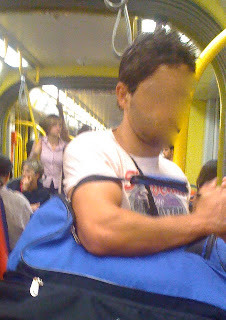
and it reminded me of one of those things I do NOT miss about America: muscle men. Now, this guy in the picture is not even the type of guy I'm referring to ~I'm just giving you an insight into my thought process here. That guy is definitely someone who works out (hence the gym bag and bicep bulging out of his arm), but it's not something you would even notice necessarily. I'm referring to those guys who spend all their free time at the gym, pumping iron and their egos, who end up looking like someone shoved an air hose up their ass. This general body type looks kinda like this faceless fellow:

Don't get me wrong, I am all for people going to the gym and keeping fit, and taking a keen interest in that as a hobby. But let's be honest here: some guys (and gals, but in a very different way) are just a little too interested in their own bodies. It's a form of narcissism. I tend to believe that many if not most of these fellows have, deep down underneath all those muscles, a real sense of insecurity. Same with the idiots who cruise around in souped-up cars (or any cars) real loud driving way too fast (reminds me: souped-up cars and monster trucks are another aspect of American culture I do not miss one bit!). A really secure man who feels naturally self-confident just doesn't need to do that. Again: I'm sure lots of secure, self-confident and kind, sensitive men are also into bodybuilding, and driving fast. But there's a fine line between being fit ~or even buff~ and being just too into yourself and too puffed-out with the muscles.
In any case, one seldom sees such bodies walking around the streets of Germany, thank god. I even considered waiting until I could get a better example than the guy pictured above whom I saw on the tram yesterday, but the truth is it could take up to a year to see one of those overly-buff muscle guys out there. They really are just that rare.
I had to ask myself: why is that? I'm really not sure, but my first thought was about German men in general. They tend to be, well, I can't think of a better word: weak. I don't mean physically puny ~the fact that the elevator at my local train stop is permanently broken and I need to ask someone to help me carry the stroller down and up the stairs every time we go to the city proves that. I mean that German men are somehow lacking in that strong, masculine, forward-moving initiative that is one of the many defining characteristics of being male. I don't mean the "mama's boy" variety of male weakness either. It's a very special quality the German men tend to have, something that brings to mind a fuzzy grey area where a "real man" should be moving about in clearly defined bold hues. Man almighty I don't feel qualified to open the can of worms squirming about right now. This is the kind of thing to be discussed in a Gender Studies or Anthropology course. I have no freaking idea why the gender roles in this country are so askew. (I'm also preparing a post about the German women ~lookout!). But somehow, they are. And I believe that may have some influence on the way German men shy away from bodybuilding like a cat avoids water.
There is, however, another side to this story (as always). I have to give credit to my German husband for letting me in on this as I asked him his view on this matter. There is also a way in which the menfolk of this land simply don't need to "prove" their manliness through their muscles. I already touched on the way muscle men are actually insecure under all the macho muscles. The muscles are only a way of proving to themselves and everyone else how manly and strong they are, when in reality they feel like helpless little kittens inside. German men would (and do) laugh at that. It's just a show. It's not real. It's superficial. One thing Germans are not is superficial (superficiality is in fact the #1 quality Germans criticize about Americans). A German man is more likely to prove his prowess through intellectual, spiritual, or creative means. And I love that! I love that the whole macho trip doesn't fly here.
One more thing: apparently there is a bodybuilding community out there. And the store they all go to for supplies, guess what it's called?
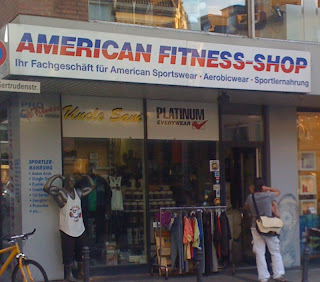
Yep, that's right: The American Fitness Shop. See the All-American, puffed out muscle mannequin standing outside the store?
Just one way American culture has seeped into Germany. But, luckily, not too much.

and it reminded me of one of those things I do NOT miss about America: muscle men. Now, this guy in the picture is not even the type of guy I'm referring to ~I'm just giving you an insight into my thought process here. That guy is definitely someone who works out (hence the gym bag and bicep bulging out of his arm), but it's not something you would even notice necessarily. I'm referring to those guys who spend all their free time at the gym, pumping iron and their egos, who end up looking like someone shoved an air hose up their ass. This general body type looks kinda like this faceless fellow:
Don't get me wrong, I am all for people going to the gym and keeping fit, and taking a keen interest in that as a hobby. But let's be honest here: some guys (and gals, but in a very different way) are just a little too interested in their own bodies. It's a form of narcissism. I tend to believe that many if not most of these fellows have, deep down underneath all those muscles, a real sense of insecurity. Same with the idiots who cruise around in souped-up cars (or any cars) real loud driving way too fast (reminds me: souped-up cars and monster trucks are another aspect of American culture I do not miss one bit!). A really secure man who feels naturally self-confident just doesn't need to do that. Again: I'm sure lots of secure, self-confident and kind, sensitive men are also into bodybuilding, and driving fast. But there's a fine line between being fit ~or even buff~ and being just too into yourself and too puffed-out with the muscles.
In any case, one seldom sees such bodies walking around the streets of Germany, thank god. I even considered waiting until I could get a better example than the guy pictured above whom I saw on the tram yesterday, but the truth is it could take up to a year to see one of those overly-buff muscle guys out there. They really are just that rare.
I had to ask myself: why is that? I'm really not sure, but my first thought was about German men in general. They tend to be, well, I can't think of a better word: weak. I don't mean physically puny ~the fact that the elevator at my local train stop is permanently broken and I need to ask someone to help me carry the stroller down and up the stairs every time we go to the city proves that. I mean that German men are somehow lacking in that strong, masculine, forward-moving initiative that is one of the many defining characteristics of being male. I don't mean the "mama's boy" variety of male weakness either. It's a very special quality the German men tend to have, something that brings to mind a fuzzy grey area where a "real man" should be moving about in clearly defined bold hues. Man almighty I don't feel qualified to open the can of worms squirming about right now. This is the kind of thing to be discussed in a Gender Studies or Anthropology course. I have no freaking idea why the gender roles in this country are so askew. (I'm also preparing a post about the German women ~lookout!). But somehow, they are. And I believe that may have some influence on the way German men shy away from bodybuilding like a cat avoids water.
There is, however, another side to this story (as always). I have to give credit to my German husband for letting me in on this as I asked him his view on this matter. There is also a way in which the menfolk of this land simply don't need to "prove" their manliness through their muscles. I already touched on the way muscle men are actually insecure under all the macho muscles. The muscles are only a way of proving to themselves and everyone else how manly and strong they are, when in reality they feel like helpless little kittens inside. German men would (and do) laugh at that. It's just a show. It's not real. It's superficial. One thing Germans are not is superficial (superficiality is in fact the #1 quality Germans criticize about Americans). A German man is more likely to prove his prowess through intellectual, spiritual, or creative means. And I love that! I love that the whole macho trip doesn't fly here.
One more thing: apparently there is a bodybuilding community out there. And the store they all go to for supplies, guess what it's called?

Yep, that's right: The American Fitness Shop. See the All-American, puffed out muscle mannequin standing outside the store?
Just one way American culture has seeped into Germany. But, luckily, not too much.
Wednesday, September 28, 2011
Oktoberfest!
Last weekend, for the second time in my life, I went to Oktoberfest. My mother-in-law lives in Munich and my own mom was visiting from the US, so we decided to take a little trip down there during this unique festival. I figure a blog themed around German culture really needs to see an entry if I go to this event, so here ya go. Because after all, if anything represents German culture, it's Oktoberfest, right? Actually, not really. Although most Americans, if asked what is "German", would recite a list of things typically seen at Oktoberfest: Lederhosen, Dirndls, big mugs of beer, pretzels, and the flags with the blue and white check design....actually these things are all typical of Bavarian culture, not exactly German culture. Well okay, the rest of Germany is also really into beer, it's true. And you can get pretzels just about anywhere. But the Lederhosen, Dirdls and all the rest of it is Bavarian. Bavaria is just one of 16 states in Germany. And it's got its very own culture. In fact, I'm not sure about this but I'd be willing to bet there's some sort of secessionist movement happening among the more deluded Bavarians out there. Bavarians tend to think Bavaria is superior to the rest of Germany and somehow special. In any case, no matter how important or dominating they try to be, it is still one of sixteen states and while its culture is quaint and unique, it is not representative of all German culture. I suppose because of the popularity of Oktoberfest and how many Americans come over just for that, that's how this image of Bavarian culture came to represent German culture to most Americans. So, just to be clear: the "German culture" seen at Oktoberfest is more "Bavarian culture" than anything. And many would argue by this point in time it's mostly just a big costume party, quite literally a song and dance production which is more about getting drunk and dancing on tables and then going on a roller coaster and throwing up, than anything truly Bavarian.
Oktoberfest lasts between 16-18 days, ends on the last Sunday of October, and has been an annual event for more than 200 years. It started out as public celebrations and horse races to celebrate the marriage of Prince Ludwig to Princess Therese in 1810 and soon became an annual event. Later an agricultural fair was added, as well as various other traditions. It is the world's largest fair and these days around 7 million people visit it each year (!!!!!).
Of course, we all know what it's really all about: drinking loads and loads of beer! There are, I believe, eight local breweries that each build their own huge beer tent (it takes about 4 months to build what is essentially the town of Oktoberfest) and serve specially brewed (and especially strong at about 6% alcohol) Oktoberfest beer in 1 liter beer mugs called Maß (remember that funny letter is like "ss", so effectively it's a Mass, which rhymes with das).

Now I'm someone who doesn't usually like beer. I'm a wino myself. But Oktoberfest beer is different. It really does taste better than regular beer (apparently they add extra sugar) and somehow the atmosphere just helps it go down easy. Maybe a little too easy....
I was there with my mom and my hubby, and we would order two at a time and sort of share them both between us. I have to say, I lost count after the second round. We started outside one of the tents in a little somewhat secluded area for our first round,

but soon moved into the tent. And then moved onto a different tent, as well as peeking our heads in a couple more besides that.

And what an amazing spectacle! The tents are varying sizes, but the larger ones hold up to 6000 people (!!!!). Each tent has a band playing in the center of the floor.

...and as the evening wares on, the dancing and singing get wilder and louder. Lots of people stand up on the benches and tables and dance, and some come crashing down ~you really do need to look out.

None of these pictures comes close to conveying the atmosphere and energy found in the beer tents at night. It's really really loud and vibrant and just crazy, in its very own Bavarian Oktoberfest sort of way. The people are all happy (an uncommon sight indeed in this country!) and friendly and it's easy to chat and dance and exchange smiles and share laughs with strangers.
After a few rounds we stumbled on over to an area where the rides are:

and rode a roller coaster called Höllenblitz, (Hell Flash). As scary as they tried to make it look from the outside, it was sure lame on the inside (I know some people like that, haha!). It was all in the dark, with some lasers and flashes going off. Oooooohhhh I'm scared!

But it was fun despite having no Flash of Hell whatsoever, as evidenced by the goofy look on my face.
On another note:
As you can imagine, Oktoberfest is no place for recovering alcoholics. Duh. Why am I bringing this up? Because, believe it or not, there is actually one place that does not serve alcohol:


You can see what a booming business they're doing. To be honest, it somehow made me sad to see that this was the most deserted corner of the whole place, not sure why as it just makes sense that people want to drink at Oktoberfest.
Notice in the first picture that they are also the only place that actually provided toys for children. We came into the Oktoberfest around 6pm, just as the day shift was heading home, and we saw plenty of kids among them. So I guess this non-alcohol place must be fuller during the day. And as a parent I am always happy to see there's somewhere that takes children into consideration and provides the likes of highchairs, crayons and paper, toys, and a kids' menu. For us, it was the ideal place to use the toilet ~no lines! Had we had Babu with us I'm sure this would've been a great place to stop for an apple juice. And actually we did consider bringing him during the day (not only are children banned from the beer tents after 8pm, but only a seriously confused parent would even think about bringing a child into that mess). But luckily my mother-in-law talked us out of it and graciously offered to babysit while we went to fill ourselves with beer at night. And as soon as we arrived it was obvious that, even during the day, this is no place for a young child. It's just too hectic and overwhelming ~a real assault on the senses. In fact we look forward to enjoying Oktoberfest with Babu someday. When he's still a kid we can go on rides together, and when he's older we can dance on tables to the worst hits of the 80s played by a Bavarian band while sucking down beer together. But until he's, I don't know, maybe three or four or maybe even older, we will steer him far clear of this event.
Friday, September 9, 2011
If you don't get the girl, go smash stuff in front of her house
I witnessed a very interesting cultural event last night and it fits perfectly to share it here.
It was around 7pm, just before dusk set in and I was cleaning up from dinner. I heard what sounded like someone dropping a glass outside on the street. Since glass tends to be broken indoors I figured this was something worth peeking out the window to see what was up. Such things constitute real excitement when you've been home with your little child all day. Before I could even get to the window I heard more crashing and clanging. What the hell?! I looked out to the street and lo and behold there was a small gathering of people ~kids and adults~ with baskets full of dishware throwing it on the street. Hey, a Polterabend!!! AAAaaaaaaaaa! I've only ever heard of this, and for whatever reason believed it was a rather outdated custom ~and it may well be.
 The word Polterabend is like so very many German words that is two (and some are even three or four) words combined to make one. Poltern means to make a racket, Abend means evening. Any American who made it through the seventies will recognize the word Polter from the movie Poltergeist. Geist means ghost, so that explains that word. Hey is Poltergeist even a word or was it just the movie title? In any case, a Polterabend is an old German tradition whereby friends and family break crockery outside the home of a couple about to wed. I knew that part, but I was curious to learn more so I looked it up on good old Wikipedia. Apparently, it comes from a German belief that "shards bring luck" ~I'd never heard that one before. It has to be dishes though, not glass. It's not exactly known where this belief and tradition come from. Some possible ideas are: from the practice of old Germanic tribes throwing shards to repel evil spirits. Or an even more ancient ritual of breaking sacrificial clay altars after they were used in ceremonies. Also mentioned was that perhaps the guy who didn't get the bride would just show up to her house the night before her wedding to someone else and break dishes to express his frustration in a manner which would not lead to anyone getting killed. This would be the most hilarious explanation for sure, but back in ye olde days I can see it being true!
Another part of this tradition is that the bride and groom have to clean up the mess:
 This part represents that the couple will have to work hard to overcome life's rough spots. Me being full of Saturn astrologically and just the way I am, I especially love that part! You can count on the Germans to include mention of life's crises in their wedding traditions. That's one thing I adore about Germans ~they do not sugar-coat anything. They are very quick to admit how hard something is (some say they complain too much and this may be true, but it's perhaps just this realism gone too far at times) and will always be honest if things aren't hunky-dory. This quality can be kind of harsh to encounter in reality, especially if you're American where you're used to everything being "just fine" and even saccharin. (Reminds me of the excellent movie American Beauty, which so poignantly portrays this aspect of American culture). In fact, it's one part of my American conditioning I try to let go of and learn from the Germans how to be more real and honest. I'm always scared of offending someone, but I sometimes have to remind myself that Germans or people who live here are not likely to be as easily offended as Americans are. They're used to brutal honesty.
I'd love to illustrate this kind of stark German honesty, but of course I'm not able to find anything in my memory bank right now even though I witness it all the time. But let's just keep this one out on the shelf and I'll keep my eyes open and report on the next incident I encounter where this comes up.
I'm also storing up some of the neat and nifty German traditions I witness as the year goes on. There are some in every season it seems. I'm looking forward to sharing my view of these old traditions that still live on. Stay tuned!
It was around 7pm, just before dusk set in and I was cleaning up from dinner. I heard what sounded like someone dropping a glass outside on the street. Since glass tends to be broken indoors I figured this was something worth peeking out the window to see what was up. Such things constitute real excitement when you've been home with your little child all day. Before I could even get to the window I heard more crashing and clanging. What the hell?! I looked out to the street and lo and behold there was a small gathering of people ~kids and adults~ with baskets full of dishware throwing it on the street. Hey, a Polterabend!!! AAAaaaaaaaaa! I've only ever heard of this, and for whatever reason believed it was a rather outdated custom ~and it may well be.

Another part of this tradition is that the bride and groom have to clean up the mess:


I'd love to illustrate this kind of stark German honesty, but of course I'm not able to find anything in my memory bank right now even though I witness it all the time. But let's just keep this one out on the shelf and I'll keep my eyes open and report on the next incident I encounter where this comes up.
I'm also storing up some of the neat and nifty German traditions I witness as the year goes on. There are some in every season it seems. I'm looking forward to sharing my view of these old traditions that still live on. Stay tuned!
Tuesday, September 6, 2011
Keeping up with the Schmitz's
Here's a little anecdote from last weekend to illustrate how the language barrier can create embarrassing situations (man oh man do I have a treasure trove of such situations, this being just the most recent):
Some neighbors of ours have an annual neighborhood party. Apparently this was the fifth annual party, although it was the first year we were invited. I reckon that having a child has earned us membership into this little group, and hence the invitation. On the invite it asked for a "Spende" for the salad buffet. Now, Spende means "donation". I had only ever heard this word used in the context of money. For example, beggars on the street ask for "eine kleine Spende" ~ a small donation. When I saw this phrasing, it did strike me as a little odd. I would figure they'd want you to rather bring a salad than money...but I have been to several German parties where the party-thrower asks for money in lieu of gifts, so I figured this was along those lines. From the American perspective this would be considered cheeky and rude. In American culture you're supposed to accept any gifts graciously, not ask for money. I suppose the onslaught in recent years in the US of registries is the way Americans are clear and direct about what they want you to give them. I've heard people now register for just about any occasion: a new baby, even bridal and baby showers. I wonder if people are doing this for their birthday wish lists as well. Here in Germany registries are unheard of, but people are not afraid to tell you what they really want: money.
So, I figured this was only odd by my American standards and I expected to see a little can on the table next to the salads for a little "donation", and I set off for the party with a 2 euro coin in my pocket. It didn't take long until I saw a few other neighbors arriving with salads or bread or some other culinary "donation" in their hands. Shit! I only stayed for 50 minutes, and I'm pretty sure not every guest brought something, so I think we were probably off the hook. But I do wonder if anyone noticed and thought me rude not to have brought a salad. It's also essential for this story (and my intellectual ego) that you know there is another German word, "Beitrag", which means "contribution". When I originally read the invitation, I had assumed if they'd meant "bring a salad" they'd have used the word Beitrag. I was wondering if perhaps Beitrag is more formal and in this context Spende would just be more friendly and casual. I asked V (the German hubster), who immediately recognized that they had meant a contribution of salad, not money, although he said he thought Beitrag would've been more appropriate and he couldn't explain to me the difference between Spende and Beitrag. Oh well.
But that's not all. I also managed to embarrass myself at this party in a way that language barriers could not excuse. I figured I was keepin' it real by not getting specially dressed for this shindig. Come as you are, ya know. I didn't put on any makeup (I wear makeup sometimes when meeting with others but not always, depending, and to work ~and then only mascara and occasionally but not always blush), I don't think I even bothered to brush my hair, and I wore my Birkenstock-style sandals I usually only wear around the house. On second thought, I could've given a moment's consideration to my appearance before leaving the house but hey, I'm a mom, what do you want? It wasn't until I was there and chatting with neighbors (most of whom I was meeting beyond just seeing-in-the-street for the first time) that I realized I was wearing a really low-cut shirt and my ample milk boobs were overflowing out the top. It was a hot muggy day and I had on my nursing tank top and a shirt on over it that was cut about the same as the nursing top, which is like a camisole. I'm not a person who routinely wears really low-cut tops and enjoys showing off my cleavage every chance I get (although I do like the cleavage I now have since becoming a breastfeeding mama, hehe). This just happened to be what I was wearing that day. Don't get me wrong: there's nothing at all wrong with a woman wearing a low-cut top. It was just inappropriate for this context. These people are relatively conservative and not what I'd call relaxed and "cool". They aren't fundamentalist right-wingers either, but just what we call in German "spießig" (that ß thingy is called "sharp s" and is like "ss", so it could also be written spiessig). Spießig, or Spießer as the proper adjective goes, is one of those beautiful German words that doesn't really have a good-enough English equivalent. The dictionary would translate it as "bourgeois", "middle class", "square", "narrow-minded", or perhaps the most accurate "white-bread". But it's the way and amount the Germans use this word where it differs. Being called a Spießer is a pretty bad insult. The real joke is, everyone calls other people spießig and thinks they themselves could never be so mediocre and normal, yet most of us (at least those of us over 30) in some way are spießig. In America, people don't generally go around and talk about how square and white-bread other people or things are. But here in Germany I hear it quite often. Anyway, these neighbors are Spießers, not the type of people you want to show up wearing a hot-pink low-cut top to their party. I was mortified. To go with the low-cut top, I was showing up alone as my husband was out of town, whereas most everyone else was with a spouse. So, they not only thought I was a mooch showing up empty-handed, but now also a slut.
On the one hand, I do care what they think, or else none of these thoughts would've entered my head. But for the most part, I really don't give a crap if they think I'm weird. In fact, I'm pretty sure they would or already did think I was weird just because, well, we are weird. Although I have become more and more spießig the older I've gotten (for example booking package holidays, which I used to balk at as being only for the non-adventurous, or the fact that I'm having a Tupperware party this weekend ~you can hardly get more spießig than that!), I still have pretty radical views compared to the average person. Sooner or later I'll start posting about our parenting philosophies and practices, which could go under the umbrella -though are not limited to- Attachment Parenting. AP (as it's known) is seen as super-weird by many, and there are even people who are adamantly against it. In any case, it is the vast minority of us who are actually dedicated to doing things this way ~unfortunately! And there are many other ways in which V and I live a pretty unconventional life, as normal and spießig as we oftentimes are. I am mostly proud of that, and it's always been my way somehow to do things differently than most everyone else. But of course there is a part of me which feels insecure when I'm at a party with our spießig neighbors, especially when my boobs are screaming up from just below my face and I've shown up to a potluck empty-handed.
Ah well!
Some neighbors of ours have an annual neighborhood party. Apparently this was the fifth annual party, although it was the first year we were invited. I reckon that having a child has earned us membership into this little group, and hence the invitation. On the invite it asked for a "Spende" for the salad buffet. Now, Spende means "donation". I had only ever heard this word used in the context of money. For example, beggars on the street ask for "eine kleine Spende" ~ a small donation. When I saw this phrasing, it did strike me as a little odd. I would figure they'd want you to rather bring a salad than money...but I have been to several German parties where the party-thrower asks for money in lieu of gifts, so I figured this was along those lines. From the American perspective this would be considered cheeky and rude. In American culture you're supposed to accept any gifts graciously, not ask for money. I suppose the onslaught in recent years in the US of registries is the way Americans are clear and direct about what they want you to give them. I've heard people now register for just about any occasion: a new baby, even bridal and baby showers. I wonder if people are doing this for their birthday wish lists as well. Here in Germany registries are unheard of, but people are not afraid to tell you what they really want: money.
So, I figured this was only odd by my American standards and I expected to see a little can on the table next to the salads for a little "donation", and I set off for the party with a 2 euro coin in my pocket. It didn't take long until I saw a few other neighbors arriving with salads or bread or some other culinary "donation" in their hands. Shit! I only stayed for 50 minutes, and I'm pretty sure not every guest brought something, so I think we were probably off the hook. But I do wonder if anyone noticed and thought me rude not to have brought a salad. It's also essential for this story (and my intellectual ego) that you know there is another German word, "Beitrag", which means "contribution". When I originally read the invitation, I had assumed if they'd meant "bring a salad" they'd have used the word Beitrag. I was wondering if perhaps Beitrag is more formal and in this context Spende would just be more friendly and casual. I asked V (the German hubster), who immediately recognized that they had meant a contribution of salad, not money, although he said he thought Beitrag would've been more appropriate and he couldn't explain to me the difference between Spende and Beitrag. Oh well.
But that's not all. I also managed to embarrass myself at this party in a way that language barriers could not excuse. I figured I was keepin' it real by not getting specially dressed for this shindig. Come as you are, ya know. I didn't put on any makeup (I wear makeup sometimes when meeting with others but not always, depending, and to work ~and then only mascara and occasionally but not always blush), I don't think I even bothered to brush my hair, and I wore my Birkenstock-style sandals I usually only wear around the house. On second thought, I could've given a moment's consideration to my appearance before leaving the house but hey, I'm a mom, what do you want? It wasn't until I was there and chatting with neighbors (most of whom I was meeting beyond just seeing-in-the-street for the first time) that I realized I was wearing a really low-cut shirt and my ample milk boobs were overflowing out the top. It was a hot muggy day and I had on my nursing tank top and a shirt on over it that was cut about the same as the nursing top, which is like a camisole. I'm not a person who routinely wears really low-cut tops and enjoys showing off my cleavage every chance I get (although I do like the cleavage I now have since becoming a breastfeeding mama, hehe). This just happened to be what I was wearing that day. Don't get me wrong: there's nothing at all wrong with a woman wearing a low-cut top. It was just inappropriate for this context. These people are relatively conservative and not what I'd call relaxed and "cool". They aren't fundamentalist right-wingers either, but just what we call in German "spießig" (that ß thingy is called "sharp s" and is like "ss", so it could also be written spiessig). Spießig, or Spießer as the proper adjective goes, is one of those beautiful German words that doesn't really have a good-enough English equivalent. The dictionary would translate it as "bourgeois", "middle class", "square", "narrow-minded", or perhaps the most accurate "white-bread". But it's the way and amount the Germans use this word where it differs. Being called a Spießer is a pretty bad insult. The real joke is, everyone calls other people spießig and thinks they themselves could never be so mediocre and normal, yet most of us (at least those of us over 30) in some way are spießig. In America, people don't generally go around and talk about how square and white-bread other people or things are. But here in Germany I hear it quite often. Anyway, these neighbors are Spießers, not the type of people you want to show up wearing a hot-pink low-cut top to their party. I was mortified. To go with the low-cut top, I was showing up alone as my husband was out of town, whereas most everyone else was with a spouse. So, they not only thought I was a mooch showing up empty-handed, but now also a slut.
On the one hand, I do care what they think, or else none of these thoughts would've entered my head. But for the most part, I really don't give a crap if they think I'm weird. In fact, I'm pretty sure they would or already did think I was weird just because, well, we are weird. Although I have become more and more spießig the older I've gotten (for example booking package holidays, which I used to balk at as being only for the non-adventurous, or the fact that I'm having a Tupperware party this weekend ~you can hardly get more spießig than that!), I still have pretty radical views compared to the average person. Sooner or later I'll start posting about our parenting philosophies and practices, which could go under the umbrella -though are not limited to- Attachment Parenting. AP (as it's known) is seen as super-weird by many, and there are even people who are adamantly against it. In any case, it is the vast minority of us who are actually dedicated to doing things this way ~unfortunately! And there are many other ways in which V and I live a pretty unconventional life, as normal and spießig as we oftentimes are. I am mostly proud of that, and it's always been my way somehow to do things differently than most everyone else. But of course there is a part of me which feels insecure when I'm at a party with our spießig neighbors, especially when my boobs are screaming up from just below my face and I've shown up to a potluck empty-handed.
Ah well!
Monday, September 5, 2011
Looking out for your safety
Before I start on this tirade, I want to say that I need to be careful that this blog doesn't carry an underlying (or not-so-under lying) theme of me complaining about German culture, and reporting only on those things that I don't get along with here. That wouldn't be fair, and it reminds me another thing Eckhart Tolle always says: the ego loves to complain! Although I think all blogs are somewhat of an ego trip...I hope I can also use this space to honestly and sincerely reflect on myself and my relationship to Germany, and other things. Plus, I love it here! If I didn't, I wouldn't have stayed as long as I have, and founded a family and be raising a child here. It would be imbalanced to report on only those German things that drive me nuts ~as I am about to do. So, I'll have to start keeping my eyes peeled for the things I love about living here. It's a good exercise for me actually.
So, without further ado, here's something that drives me absolutely freaking mad. Actually, let me introduce this rant another way. This lovely reminder is painted on the wall at a nearby tram station:

It says: Order, Cleanliness, Security (or Safety, depending on context)
This about sums up the German view of life. It's gotta be risk-free and predictable. I heard that Germans are the most insured people in the world, and I'm sure this is true.
These pillars of German society (again, that's order, cleanliness and security) can be seen all over the streets and in the minds of the people. It goes very deep. One facet of this mindset I want to share today, something which drives me nuts on a daily basis, slowing down my bike rides and marring the beauty of our streets and pathways:

I don't even know how the hell you would call these gems of German-ness. Blockades? They are every-friggin-where! There is hardly a path that doesn't have these blocking the way. This is one of three I have to try and maneuver my bike through when I take Max to daycare. The other two look like this:


and are at either end of an underpass going under the train tracks. I have to go through this underpass in order to leave our little corner of the neighborhood and get anywhere, so I ride around these many times a day often. When we first moved here three years ago these weren't there, but about 1 1/2 years ago they suddenly appeared, much to my chagrin. I curse them just about every time I have to try and get through them. You see, I'm just not a graceful and adept enough bicyclist to be able to smoothly pedal through. I usually end up having to stop riding and use my foot to sort of guide me through, half-walking. Or sometimes I even have to get off and push the bike through (especially on the one going 'up'). I especially curse Germany when that happens. Once, only once, was I able to actually glide through on both ends. I was ecstatic! I try to make this an exercise in not complaining, as well as an exercise in improving my bicycling skills.
But really, most days, I am not that enlightened and I view this as an annoying and unnecessary obstacle course. I do get why they think this makes it safer. Hell, before they were there, sometimes someone (most often a teenage boy) would come barreling down the path and not bother to ding the bell to warn a potential person coming in the other direction (there's a blind corner) and it would be a collision course. I was never actually run into, but did have one or two close calls that made me jump out of my skin. So, in one sense, that danger is gone. Maybe these ones aren't the best example in fact. Look again at the first picture. The path is clear in both directions and it's flat. There would be zero danger whatsoever. These barricades are placed at nearly every path, and most of them are flat and safe. They just want to slow people down. Again, it is pretty much only teenage boys who are racing around without regard for safety. Everyone else is more or less paying attention and safe and considerate, with or without these dumb blockades. And the teenage boys are going to be unsafe and risky no matter what anyway. It is their parents' job to instill some sense of caution and consideration into them, not the German government's.
But the German government takes it upon themselves to look out for all of our safety, hence creating a populace who are overly fearful, afraid of change and averse to taking risks. I could go on and on all day here, but one example that comes to mind is Germans and dancing at concerts. I love live music and going to concerts and dancing. To me, that is medicine. Well, many of the concerts I've been to here have left me aghast at what I saw there: an audience of statues, just standing there as if they were watching the tickertape run on the stock market or something. Of course I always dance, but many times I've been the only one. If V (my hubby) is with me he dances too and we have a blast. But I've been to lots of shows alone and it is much less fun being the singular dancer amongst people who are frozen stiff, some of them looking at me like I were the who was out of place. It has literally left me in tears at times (okay, the fact that I may have had a few too many glasses of Sekt may or may not have had something to do with me getting all emo about it). Anyway, I digress. But it's just one of many many examples where you can see that Germans are frozen in fear. It's not their fault. Let's just blame the government! No really, there's a long history to this I'm sure, and the Germans are doing their best.
Hey it reminds me: I realize I'm making broad generalizations when I use "the Germans" in a sentence. It's not fair and it's not right. It sometimes gets on my nerves when people do that about Americans. Like: "Americans are so phony, asking 'How are you?' when they couldn't care less". For the most part that's accurate....but not all Americans are like that and I certainly don't want to be put in that box myself. Furthermore, there's a flip side to that coin: Americans are friendly and being friendly is a very important quality to have (this said by one whose beloved amazing astrologer once said "You're not what they call a 'nice person'"). I may not be overly friendly, but it's a quality I would like to cultivate more in myself, and I truly appreciate it when people are friendly to me. Anyway, there is a flip side to the German over-cautiousness: Germans are very thorough in forming their opinions, and will always dig deeper and look at the aspects others might miss. They have a piercing intellect which wants to know more and understand fully, not just superficially. No wonder so many of the world's best scientists, mathematicians and philosophers have been Germans.
Well, whether I'm praising or cursing the Germans, I do see how unfair it is to make these generalizations. I do try to see each person as an individual, not just someone from this or that culture. It's so important to be able to do this. We are so much more than our backgrounds, even though our backgrounds do condition how we see and relate to the world. So, I just wanted to say that to be clear. And for the purpose of this blog, I am going to say things about 'the Germans' or 'Americans', or any number of other groups of people. I just don't see any way around that when talking about culture and people. Please know that I know better though, than to believe all Germans or all Americans are a certain way. I know you know better as well.
So, without further ado, here's something that drives me absolutely freaking mad. Actually, let me introduce this rant another way. This lovely reminder is painted on the wall at a nearby tram station:

It says: Order, Cleanliness, Security (or Safety, depending on context)
This about sums up the German view of life. It's gotta be risk-free and predictable. I heard that Germans are the most insured people in the world, and I'm sure this is true.
These pillars of German society (again, that's order, cleanliness and security) can be seen all over the streets and in the minds of the people. It goes very deep. One facet of this mindset I want to share today, something which drives me nuts on a daily basis, slowing down my bike rides and marring the beauty of our streets and pathways:

I don't even know how the hell you would call these gems of German-ness. Blockades? They are every-friggin-where! There is hardly a path that doesn't have these blocking the way. This is one of three I have to try and maneuver my bike through when I take Max to daycare. The other two look like this:


and are at either end of an underpass going under the train tracks. I have to go through this underpass in order to leave our little corner of the neighborhood and get anywhere, so I ride around these many times a day often. When we first moved here three years ago these weren't there, but about 1 1/2 years ago they suddenly appeared, much to my chagrin. I curse them just about every time I have to try and get through them. You see, I'm just not a graceful and adept enough bicyclist to be able to smoothly pedal through. I usually end up having to stop riding and use my foot to sort of guide me through, half-walking. Or sometimes I even have to get off and push the bike through (especially on the one going 'up'). I especially curse Germany when that happens. Once, only once, was I able to actually glide through on both ends. I was ecstatic! I try to make this an exercise in not complaining, as well as an exercise in improving my bicycling skills.
But really, most days, I am not that enlightened and I view this as an annoying and unnecessary obstacle course. I do get why they think this makes it safer. Hell, before they were there, sometimes someone (most often a teenage boy) would come barreling down the path and not bother to ding the bell to warn a potential person coming in the other direction (there's a blind corner) and it would be a collision course. I was never actually run into, but did have one or two close calls that made me jump out of my skin. So, in one sense, that danger is gone. Maybe these ones aren't the best example in fact. Look again at the first picture. The path is clear in both directions and it's flat. There would be zero danger whatsoever. These barricades are placed at nearly every path, and most of them are flat and safe. They just want to slow people down. Again, it is pretty much only teenage boys who are racing around without regard for safety. Everyone else is more or less paying attention and safe and considerate, with or without these dumb blockades. And the teenage boys are going to be unsafe and risky no matter what anyway. It is their parents' job to instill some sense of caution and consideration into them, not the German government's.
But the German government takes it upon themselves to look out for all of our safety, hence creating a populace who are overly fearful, afraid of change and averse to taking risks. I could go on and on all day here, but one example that comes to mind is Germans and dancing at concerts. I love live music and going to concerts and dancing. To me, that is medicine. Well, many of the concerts I've been to here have left me aghast at what I saw there: an audience of statues, just standing there as if they were watching the tickertape run on the stock market or something. Of course I always dance, but many times I've been the only one. If V (my hubby) is with me he dances too and we have a blast. But I've been to lots of shows alone and it is much less fun being the singular dancer amongst people who are frozen stiff, some of them looking at me like I were the who was out of place. It has literally left me in tears at times (okay, the fact that I may have had a few too many glasses of Sekt may or may not have had something to do with me getting all emo about it). Anyway, I digress. But it's just one of many many examples where you can see that Germans are frozen in fear. It's not their fault. Let's just blame the government! No really, there's a long history to this I'm sure, and the Germans are doing their best.
Hey it reminds me: I realize I'm making broad generalizations when I use "the Germans" in a sentence. It's not fair and it's not right. It sometimes gets on my nerves when people do that about Americans. Like: "Americans are so phony, asking 'How are you?' when they couldn't care less". For the most part that's accurate....but not all Americans are like that and I certainly don't want to be put in that box myself. Furthermore, there's a flip side to that coin: Americans are friendly and being friendly is a very important quality to have (this said by one whose beloved amazing astrologer once said "You're not what they call a 'nice person'"). I may not be overly friendly, but it's a quality I would like to cultivate more in myself, and I truly appreciate it when people are friendly to me. Anyway, there is a flip side to the German over-cautiousness: Germans are very thorough in forming their opinions, and will always dig deeper and look at the aspects others might miss. They have a piercing intellect which wants to know more and understand fully, not just superficially. No wonder so many of the world's best scientists, mathematicians and philosophers have been Germans.
Well, whether I'm praising or cursing the Germans, I do see how unfair it is to make these generalizations. I do try to see each person as an individual, not just someone from this or that culture. It's so important to be able to do this. We are so much more than our backgrounds, even though our backgrounds do condition how we see and relate to the world. So, I just wanted to say that to be clear. And for the purpose of this blog, I am going to say things about 'the Germans' or 'Americans', or any number of other groups of people. I just don't see any way around that when talking about culture and people. Please know that I know better though, than to believe all Germans or all Americans are a certain way. I know you know better as well.
Subscribe to:
Posts (Atom)